Botë · BBC
European leaders converge on Armenia as Russia looks on
Two European summits are being held in a country long considered Russia's closest ally in the region. 12 hours ago Share Save Add as preferred on Google Rayhan Demytrie South Caucasus correspondent, in Yerevan European leaders are descending on Armenia for two unprecedented summits in a country long considered Russia's closest ally in the South Caucasus.
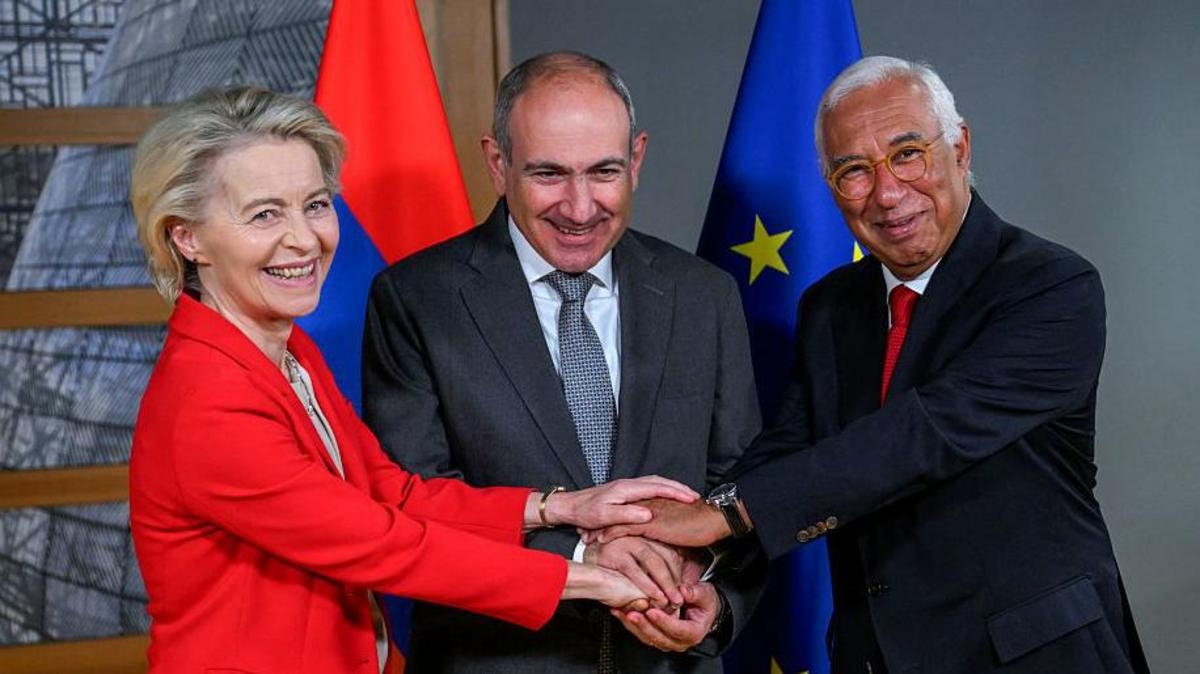
Two European summits are being held in a country long considered Russia's closest ally in the region. 12 hours ago Share Save Add as preferred on Google Rayhan Demytrie South Caucasus correspondent, in Yerevan European leaders are descending on Armenia for two unprecedented summits in a country long considered Russia's closest ally in the South Caucasus. The symbolism for this country of fewer than three million people is hard to overstate; Armenia is a member of Russian President Vladimir Putin's Eurasian Economic Union, and Moscow hosts a military base on Armenian soil. On Monday, more than 30 European leaders and Canada's prime minister will take part in a European Political Community (EPC) summit in the capital Yerevan. Tuesday will then see the first ever bilateral EU-Armenia summit, attended by European Commission President Ursula von der Leyen and European Council President António Costa.
Armenia is heavily dependent on Russia for energy resources. Russia sells gas to Armenia for $177.50 (£130.30) per 1,000 cubic metres, he noted, while in Europe it costs $600 (£440.40). How did a country this embedded in Russia's orbit end up hosting most of Europe's leaders? The turning point was Armenia's 2023 war with its neighbour Azerbaijan. "The physical presence of the European Union shifted the perceptions of our citizens," said Khandanyan.
The peace process between Armenia and Azerbaijan has also accelerated. There, they also announced the Trump Route for International Peace and Prosperity – a major connectivity corridor which will run along Armenia's border with Iran, linking the region to European markets. Meanwhile, Moscow has watched Armenia's increasingly warm relations with the EU with undisguised irritation. "Social media sites are 100% free in Armenia, with no limitations," he told the Russian leader. In Russia, all major Western platforms are blocked.
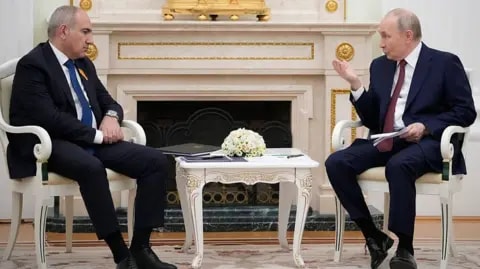
But Putin reminded Pashinyan that his EU membership ambitions were incompatible with Eurasian Economic Union membership. "It is not possible to be simultaneously in a customs union with both the European Union and the Eurasian Economic Union," he said. "It is simply impossible by definition." Just days before Monday's EPC summit, Russia banned the import of Armenian mineral water. Last month, the EU approved a new civilian mission for Armenia for the next two years - designed to counter Russian disinformation, cyberattacks and illicit financial flows, particularly ahead of Armenia's parliamentary elections in June. In a separate operation, hackers created a fake Signal account impersonating the EU Ambassador in Armenia Vassilis Maragos, and invited NGO leaders to a fake conference on Armenia-EU relations.
His main concerns ahead of Armenia's June elections were foreign interference, disinformation and political polarisation online. While European leaders are heading to Yerevan with promises of civilian missions and visa liberalisation in the next two years, there is no timeline for EU membership, defence commitments nor any plan to replace Russian gas. Without such firm commitments, Armenia's "balancing act" between Russia and the West is far from over. Europe Russia Armenia Two European summits are being held in a country long considered Russia's closest ally in the region. European leaders converge on Armenia as Russia looks on