Kulturë · The Guardian
Strength in numbers: what have 50 years of labor union documentaries shown us?
Since the release of defining 70s doc Harlan County, USA, film-makers have captured workers’ tenacity and solidarity “We better start pulling together or, by God, they’re going to bury us,” says a meat packer during a union meeting in Barbara Kopple’s 1990 documentary American Dream. It’s a desperate plea for survival; “they” are the Hormel Foods Corporation, who took advantage of union disorder to replace a huge portion of their workforce during a costly strike.
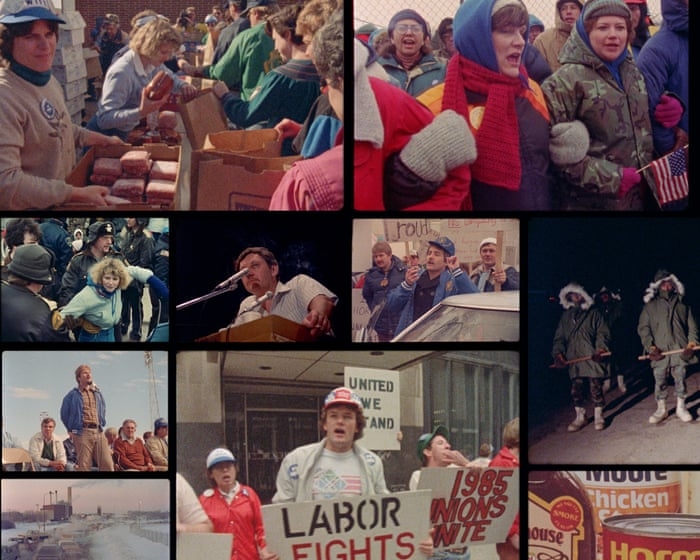
Since the release of defining 70s doc Harlan County, USA, film-makers have captured workers’ tenacity and solidarity “We better start pulling together or, by God, they’re going to bury us,” says a meat packer during a union meeting in Barbara Kopple’s 1990 documentary American Dream. It’s a desperate plea for survival; “they” are the Hormel Foods Corporation, who took advantage of union disorder to replace a huge portion of their workforce during a costly strike. American Dream sees the 1985-86 labor crisis in Austin, Minnesota, as symbolic of the state of organized labor in the United States – call it an alternative State of the Union address. American Dream takes place in the Reagan years, characterized by an uncompromising approach to union power: in 1981, the president threatened striking air traffic controllers with termination if they didn’t return to work in 48 hours; private companies like Hormel, Phelps Dodge, and International Paper increasingly replaced striking workers; and unions lost 2.7 million members from 1980 to 1984. Since the release of defining 70s doc Harlan County, USA, film-makers have captured workers’ tenacity and solidarity “W e better start pulling together or, by God, they’re going to bury us,” says a meat packer during a union meeting in Barbara Kopple’s 1990 documentary American Dream.
It’s a desperate plea for survival; “they” are the Hormel Foods Corporation, who took advantage of union disorder to replace a huge portion of their workforce during a costly strike. American Dream sees the 1985-86 labor crisis in Austin, Minnesota, as symbolic of the state of organized labor in the United States – call it an alternative State of the Union address. American Dream takes place in the Reagan years, characterized by an uncompromising approach to union power: in 1981, the president threatened striking air traffic controllers with termination if they didn’t return to work in 48 hours; private companies like Hormel, Phelps Dodge, and International Paper increasingly replaced striking workers; and unions lost 2.7 million members from 1980 to 1984. The film, which has been restored and is re-released this week by Janus Films, was Kopple’s follow-up to Harlan County, USA, about the 1973 Brookside strike in a Kentucky coalmine. The film, which celebrates its 50th anniversary later this year, is a more empowering watch than American Dream.
But the DNA of Harlan County, USA is also present in the many union and strike documentaries that followed it: Final Offer, about the 1984 contract negotiations with General Motors, and American Standoff, about a fraught Teamsters strike against company Overnite Transportation beginning in 2000. More recently, Union followed the Amazon Labor Union’s historic attempt to unionize an Amazon warehouse on Staten Island, while the upcoming Who Moves America is a nationwide survey of UPS drivers preparing to strike as Teamster negotiators fight for an acceptable contract. Be it meat packers, miners, couriers or warehouse workers, film-makers gain the trust of workers who risk everything, and the subsequent films are temperature checks on organized labor in the United States. The similarities in content and style proves that an essential labor crisis has remained constant from Harlan County, USA onwards, but each film’s ground-level focus and specificity means the subgenre reflects a changing landscape of American labor. For some, the history of union action has shifted from shared community memory towards antiquated irrelevancy.
The striking miners in Harlan County, USA stand in the shadow of the Harlan County War, a series of strikes and skirmishes during the 1930s that racked up more than a dozen fatalities. “Bloody Harlan” is invoked throughout Kopple’s film, including when singer Florence Reece sings her protest anthem Which Side Are You On?, originally written during previous Harlan County strikes. The recent documentaries point to the gulf between union diehards and those who must be convinced of solidarity’s worth as a union’s largest vulnerability. American Dream contains all the seeds for the corporate makeovers that altered the discourse surrounding unions. In Union, union-busting is the remit of PowerPoint-wielding consultants, like those hired to sequester Amazon employees in conference rooms and convince them not to organize.
Explore more on these topics Share Reuse this content Since the release of defining 70s doc Harlan County, USA, film-makers have captured workers’ tenacity and solidarity “We better start pulling together or, by God, they’re going to bury us,” says a meat packer during a union meeting in Barbara Kopple’s 1990 documentary American Dream. It’s a desperate plea for survival; “they” are the Hormel Foods Corporation, who took advantage of union disorder to replace a huge portion of their workforce during a costly strike. American Dream sees the 1985-86 labor crisis in Austin, Minnesota, as symbolic of the state of organized labor in the United States – call it an alternative State of the Union address. American Dream takes place in the Reagan years, characterized by an uncompromising approach to union power: in 1981, the president threatened striking air traffic controllers with termination if they didn’t return to work in 48 hours; private companies like Hormel, Phelps Dodge, and International Paper increasingly replaced striking workers; and unions lost 2.7 million members from 1980 to 1984. Strength in numbers: what have 50 years of labor union documentaries shown us?